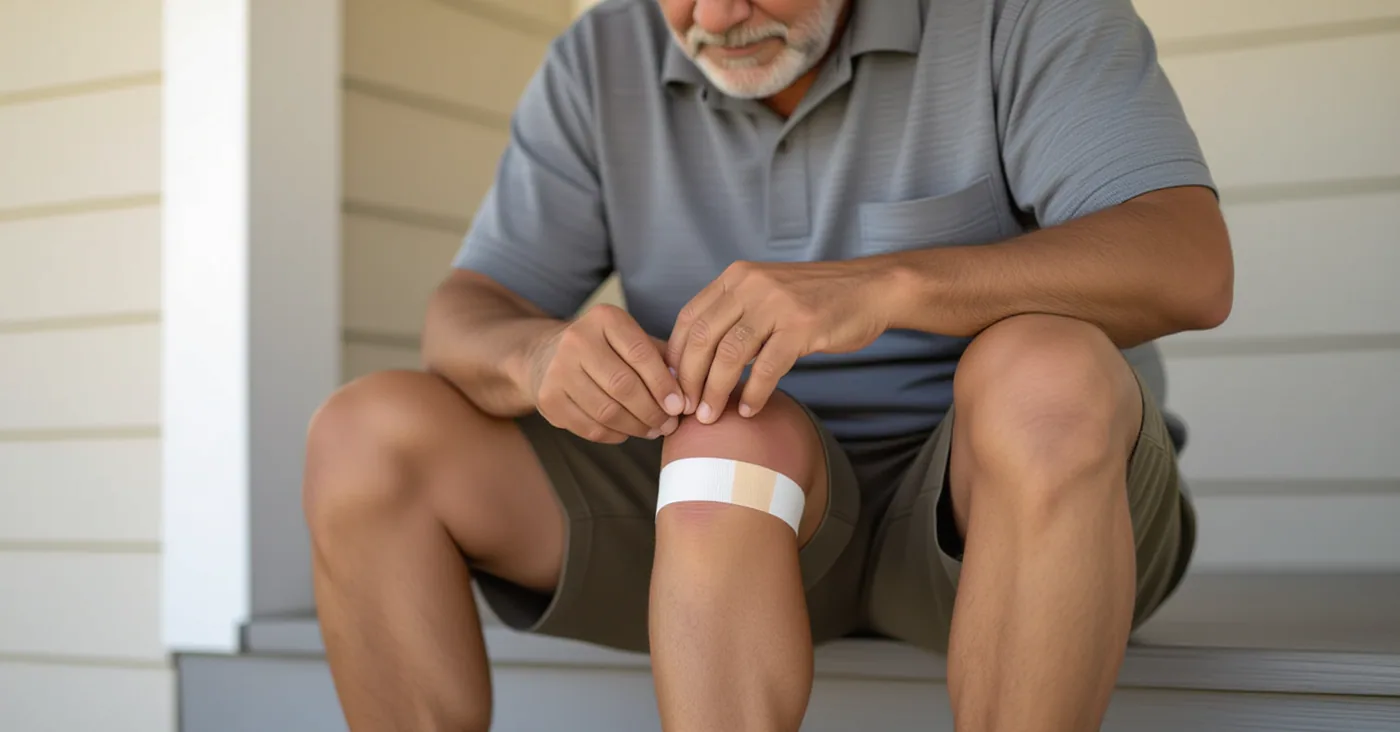
You hit the pavement. Your knee is raw, bleeding, stinging. You're standing in traffic or on a parking lot looking down at what looks like a mess. The first five minutes after a scrape set the trajectory for healing. Get them right and you avoid infection, scarring, and a trip to the ER. Get them wrong and that "minor road rash" becomes a wound that stays open for weeks.
Here's what to do, what not to do, and the moment the scrape stops being a first-aid problem and starts being a legal one.
What to Do Immediately After Scraping Your Knee
The instinct after a fall is to rush, wipe, and hope. That's how you grind gravel into tissue. Follow this protocol. It's standard first-aid guidance, nothing fancy, just discipline.
-
Stop the bleeding. Apply gentle, steady pressure with a clean cloth or sterile gauze for 5–10 minutes. Don't peek every 30 seconds. Constant lifting breaks the clot forming at the surface. If the blood soaks through the cloth, add another layer on top; don't remove the first one.
-
Rinse the wound. Hold it under clean, cool running water for 2–3 minutes. Tap water is fine. No need for bottled water or saline unless you have it. This flushes out debris without damaging the tissue. Do NOT use hydrogen peroxide or rubbing alcohol. They look dramatic in movies but they destroy healthy cells and delay healing. A scraped knee is an open wound; treat it like one, not a science experiment.
-
Remove visible debris. Use tweezers cleaned with alcohol to pluck out gravel or dirt sitting on the surface. Do not dig into the wound. If something is embedded and won't come out with gentle pressure, leave it and let a clinician handle it. Digging creates deeper channels for bacteria.
-
Apply antibiotic ointment. A thin layer of Neosporin or Bacitracin if you're not allergic to it. This keeps the wound moist (dry scabs crack) and adds a bacterial barrier. Skip it if the scrape is very large and raw. Sometimes plain petroleum jelly does the job.
-
Cover it. Sterile bandage or non-stick dressing. Change daily, or anytime it gets wet or dirty. A covered scrape heals faster and looks less intimidating than a weeping one.
What NOT to do
- Don't scrub the scrape with a washcloth or sponge. You're abrading raw tissue further.
- Don't apply ice directly to an open scrape. Ice numbs pain but constricts blood flow needed for healing.
- Don't ignore it because "it'll heal on its own." Scrapes on the knee are high-friction zones. Every step rubs the wound against your pants.
When to seek immediate medical attention
Go to urgent care or the ER now if: the bleeding won't stop after 10 minutes of firm pressure, the scrape is larger than your palm, you can see fat, muscle, or bone, or the knee feels unstable. These aren't road rash anymore. They're injuries that need sutures or evaluation.
Scraped Knee vs. Serious Knee Injury: How to Tell the Difference

A scraped knee (road rash) is a superficial injury. Epidermis and upper dermis only. It bleeds, it stings, it looks worse than it is. But the knee is a hinge joint, and falls that produce scrapes often produce deeper damage that the scrape itself masks. Here's how to tell them apart.
| Feature | Scraped Knee (Road Rash) | Serious Knee Injury |
|---|---|---|
| Depth | Epidermis + upper dermis only | Exposes bone, joint capsule, or ligament |
| Bleeding | Superficial ooze; stops with pressure | Deep pooling; won't stop with gentle pressure |
| Pain | Sharp surface pain; dull ache underneath | Deep, structural pain; often impossible to bear weight |
| Range of motion | Full flexion/extension, painful but possible | Cannot straighten leg; knee "gives out" |
| Visible signs | Redness, minor swelling, raw surface | Deformity, bruising spreading up/down the thigh/calf, grinding sensation |
| Onset | Immediate, obvious | Can be delayed 1–2 hours as swelling builds |
If the scrape is on the front of the knee and you cannot straighten your leg, suspect a patellar or ligament injury. The scrape may be superficial while the real problem — a torn ACL, a patellar fracture, a meniscus tear — is hiding beneath it. In Greenville, SC, urgent care clinics can evaluate both superficial scrapes and deeper injuries quickly. Don't assume a "minor" scrape after a car crash or slip-and-fall means nothing happened below the skin. A Greenville car accident victim sometimes walks away from the scene thinking they're fine until three days later when the knee locks up.
Infection Risk and When to See a Doctor in Greenville
A scraped knee is an open door for bacteria. Staphylococcus aureus (staph) is the usual suspect. It lives on skin, in soil, and in the gravel that ground itself into your wound. Left unchecked, staph can move from a surface scrape into the joint space and cause septic arthritis — a joint infection that can destroy cartilage permanently if untreated.
Infection can develop within 24–72 hours after the initial scrape. That's the window where most people say "I'll watch it" and then show up with a swollen, hot knee two days later. Here's what happens in a real case:
Say you fell off your bike on a gravel path near downtown Greenville. You scraped your right knee on asphalt, rinsed it with tap water, put a bandage on it, and went home. By hour 36, the area around the wound feels warm. The redness has spread past the original scrape boundary by half an inch. There's yellow pus at the edges and you have a low-grade fever. This is not "normal healing." This is cellulitis starting. You call urgent care, they open the wound, irrigate it deeply, prescribe oral antibiotics, and give you a tetanus shot because yours was eight years old. The cost and time lost depend on your insurance plan and your employer's leave policy — no one can quote those numbers for you. All avoidable if you'd gone in at hour 18 instead of hour 36.
Greenville residents should visit an urgent care clinic or emergency room if: the wound is larger than 2 inches, debris is deeply embedded and won't come out, or any infection signs appear (increasing redness, warmth, swelling, pus, fever, or red streaks spreading from the wound). A tetanus shot may be needed if your last one was more than 5 years ago for a dirty wound. Dirt and gravel are not sterile.
What to expect at urgent care
They'll irrigate the wound (usually with saline under pressure), remove any remaining foreign material, assess whether sutures are needed, prescribe antibiotics if infection is present or likely, and update your tetanus status. It takes 30–45 minutes. Walk in, not the next morning.
When to go to the ER vs. urgent care
ER if: the knee is deformed, you cannot bear any weight, there's a deep laceration exposing bone or joint, or you hit your head during the fall. Urgent care if: it's a scrape, the knee moves but hurts, there's minor swelling, no deformity. The difference matters because ER wait times in Greenville can be 3+ hours. Urgent care is often walk-in within 30 minutes.
When a Scraped Knee After an Accident Means You Should Call a Lawyer

A scraped knee from a car accident, bicycle crash, or slip-and-fall on someone else's property may look like a first-aid story. But scrapes don't exist in isolation. They're the visible tip of a chain of events: a driver failed to brake, a property owner left ice unshoveled, a road had a pothole that wasn't marked. Your scrape is one data point in a negligence claim.
Even "minor" scrapes can lead to significant medical bills, scarring, and lost wages if the accident was caused by another party's negligence. A scraped knee that gets infected costs hundreds. A scraped knee that leads to a missed week of work costs thousands. And if the scrape is part of a larger injury — a concussion from the fall, a whiplash from the car impact, a torn ligament you didn't notice until the adrenaline wore off — the total damages compound fast.
In South Carolina, the statute of limitations for personal injury claims is three years from the date of the accident. That's not a suggestion. It's the law. Miss the window and your case is dead regardless of how strong it was. This deadline applies to Greenville-area claims whether the incident happened in Greenville, Mauldin, or anywhere else in the Upstate.
The 3-question test: should you call a lawyer?
Ask yourself these three questions about the accident that gave you the scrape:
- Was someone else responsible? (A driver ran a red light. A store left a wet floor unmarked. A city failed to maintain a road.)
- Did the accident cause more than the scrape? (Lost wages from missed work. Scarring that affects your appearance or function. Medical bills from infection treatment or follow-up care.)
- Is it within three years of the incident? (If yes, you still have legal standing. If no, consult an attorney immediately — there may be exceptions for minors or delayed discovery.)
Answer "yes" to two or more of these, and you have a valid claim worth investigating. The other half of the equation is documentation. Take photos of the wound, the scene, the skid marks, the weather conditions. Get witness names. Don't sign any settlement offer from an insurance adjuster before talking to counsel. Settlement timelines vary widely by case complexity, insurer responsiveness, and whether liability is disputed. Some resolve in a few months; others take over a year. What's consistent is this: the first offer is rarely the final one.
Get a Free Case Evaluation from Accident Lawyer Greenville
Your scraped knee might be the only thing you noticed at the time. The rest of the damage — the concussion you brushed off, the back pain that flared up weeks later, the insurance company's lowball offer — doesn't matter if you never file the claim. Here's what to do next:
- [ ] Confirm the accident date is within three years of today
- [ ] Gather your medical records (urgent care visit, infection treatment, any follow-up)
- [ ] Photograph the scrape, the scene, and any visible injuries (before they fade)
- [ ] Collect witness contact info and any police or incident reports
- [ ] Call Accident Lawyer Greenville for a free, no-obligation case evaluation
The firm handles car accidents, bicycle accidents, slip-and-fall cases, and other personal injury claims across the Greenville area. There's no upfront cost, no obligation to hire them after the call, and no pressure. If your scraped knee resulted from an accident caused by someone else, you may be entitled to compensation for medical bills, pain and suffering, and lost wages. A free case evaluation takes 20 minutes on the phone and costs you nothing to find out whether you have a case worth pursuing.